
 Horse Racing Form Guides: What the Numbers and Abbreviations Mean | Cricbet99
 2026-09-09
Horse racing form guides provide valuable information that helps followers understand a horse’s previous performances, racing history, and potential strengths. These guides may look complicated at first because they contain numbers, symbols, and abbreviations that represent different aspects of a horse’s record. On Cricbet99, users exploring horse racing information can benefit from understanding how to read form guides and interpret the details shown before a race.
Learning these basic terms makes it easier to understand past results, track performance patterns, and compare different runners.
What Is a Horse Racing Form Guide?
A horse racing form guide is a collection of information about a horse’s previous races.
It usually includes details such as:
- Recent finishing positions
- Race dates
- Track conditions
- Distance records
- Trainer information
- Jockey details
- Weight carried
- Race class
Form guides help provide background information before a race begins.
After completing a Cricbet99 Login, users reviewing racing markets can use form information as one part of understanding race conditions.
Understanding Form Numbers
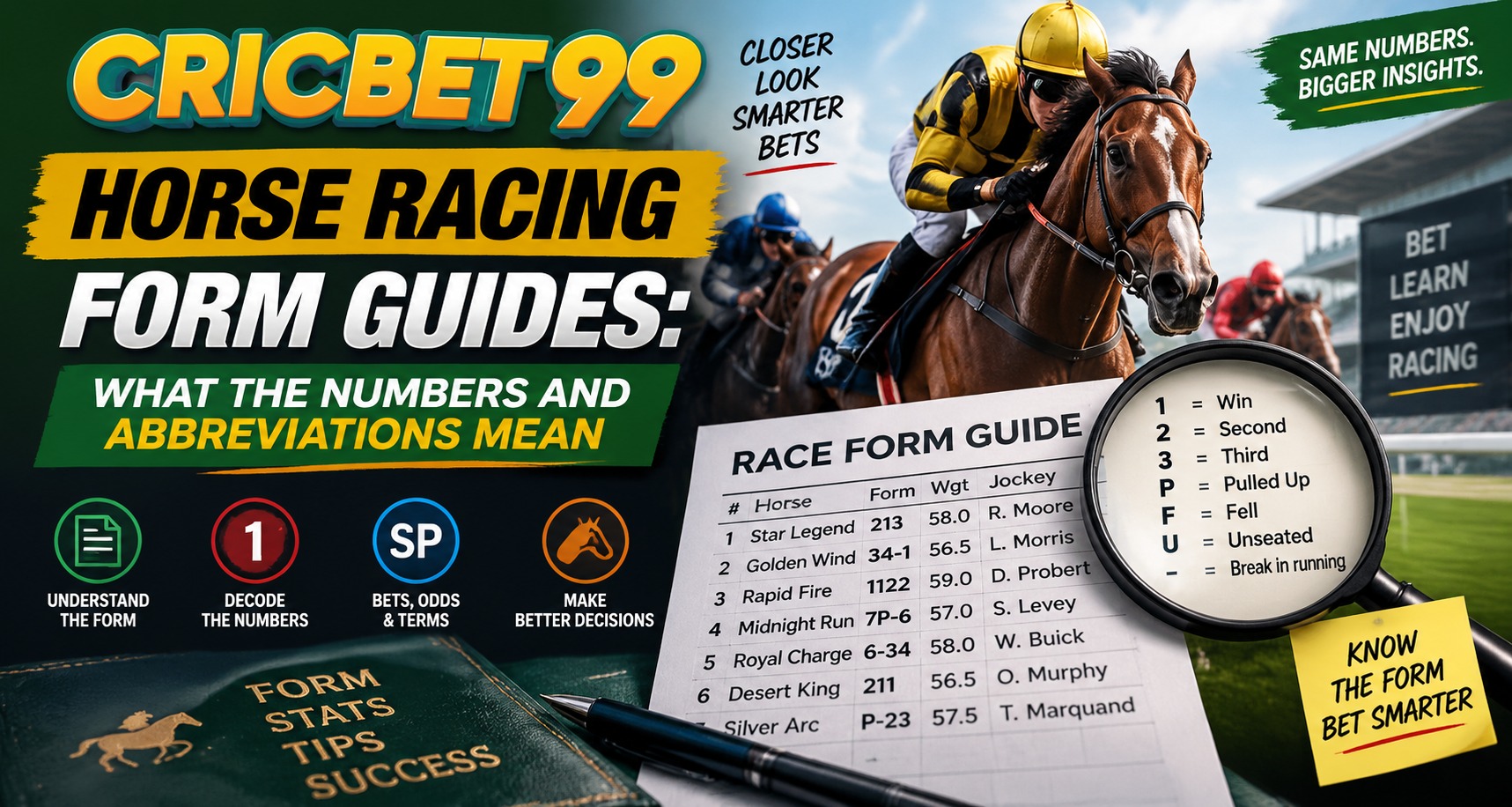
The numbers displayed in a form guide usually represent a horse’s finishing positions in previous races.
For example:
- 1 = Finished first
- 2 = Finished second
- 3 = Finished third
- 4 = Finished fourth
If a horse’s recent form shows:
5-2-1-3
It means:
- Fifth place in one race
- Second place in another race
- First place in another race
- Third place in another race
Recent results help show consistency, but they do not guarantee future performance.
What Does “0” Mean in Horse Racing Form?
A “0” usually represents a finishing position outside the main listed places.
For example, if a horse finishes beyond the positions displayed in the form guide, it may be recorded as 0.
This helps users understand that the horse did not achieve a notable finishing position in that race.
Understanding Letters in Form Guides
Horse racing form guides often include letters that provide additional information.
Common abbreviations include:
F – Fell
The horse fell during the race and did not complete the event.
P – Pulled Up
The jockey stopped the horse before finishing because continuing was not considered suitable.
U – Unseated Rider
The jockey was removed from the horse during the race.
R – Refused
The horse refused to start or continue as expected.
These symbols provide context beyond simple finishing positions.
What Do Track and Distance Records Mean?
A horse’s previous experience on specific tracks and distances can be important.
Form guides may include information about:
- Previous track performances
- Distance suitability
- Surface preferences
- Historical results
Some horses perform better over certain distances because of their running style and stamina.
Understanding Weight Information
Weight is another important part of horse racing analysis.
The weight carried by a horse can influence performance because additional weight may affect speed and endurance.
Form guides may show:
- Assigned race weight
- Weight changes
- Previous carried weight
Comparing weight differences can help explain changes in performance.
Trainer and Jockey Information
The combination of trainer and jockey can provide useful background information.
A form guide may include:
- Trainer name
- Jockey name
- Previous partnership results
- Recent performance statistics
Experienced combinations may have a better understanding of a horse’s preferred strategy and conditions.
Understanding Race Class Information
Horse races are often divided into different classes based on competition level.
Form guides may mention:
- Maiden races
- Handicap races
- Listed races
- Group races
A horse performing well in a stronger race class may have different expectations when competing against a different level of opposition.
How Recent Form Helps Analysis
Recent performance is one of the most commonly reviewed parts of a form guide.
Users may look for:
- Consistent finishing positions
- Improving performances
- Previous wins
- Strong finishes
- Poor results under certain conditions
However, recent form should always be considered along with other factors.
Common Mistakes When Reading Form Guides
Beginners may misunderstand form information by:
Focusing Only on Wins
A horse finishing consistently near the front may still be competitive without frequent wins.
Ignoring Track Conditions
A horse’s previous results may depend heavily on surface conditions.
Forgetting Race Quality
A win in a lower-level race may not always compare with performance against stronger opponents.
Looking Only at One Race
A single result does not always represent a horse’s overall ability.
How Form Guides Support Better Race Understanding
Form guides are useful because they provide a wider view of a horse’s racing history.
When reviewing information through Cricbet99 Com, users can consider factors such as:
- Recent form
- Track experience
- Distance suitability
- Trainer performance
- Jockey records
Combining multiple details provides a more complete understanding of race conditions.
Using Form Information for Horse Racing Analysis
For users interested in Cricbet99 Online Betting, form guides can provide helpful background information before a race.
Important points to review include:
- Current form trend
- Previous race conditions
- Competition level
- Horse fitness information
- Weight changes
Form guides should be viewed as informational tools rather than guaranteed predictions.
Why Understanding Abbreviations Matters
Horse racing uses many terms that can appear confusing to new followers.
Learning abbreviations helps users quickly understand:
- What happened in previous races
- Why a result occurred
- How a horse performed under different conditions
- What factors may influence future races
Knowledge of these terms makes racing analysis easier and more enjoyable.
Conclusion
Horse racing form guides contain important information about previous performances, but understanding the numbers and abbreviations is essential for reading them correctly. Finishing positions, race conditions, weight details, and performance symbols all provide valuable context.
By learning how to interpret form guides, users can better understand race history, compare horses, and follow racing discussions with greater confidence. A complete view of the available information helps create a clearer picture of each race.
FAQs
What do the numbers in a horse racing form guide mean?
Numbers usually represent a horse’s finishing positions in previous races, with lower numbers showing better finishes.
What does “F” mean in horse racing form?
“F” usually means the horse fell during the race and did not complete the event.
Why is track condition important in horse racing?
Different horses perform better on different surfaces, so track conditions can influence race performance.
Can form guides predict the winner of a race?
No. Form guides provide historical information, but race outcomes depend on many factors.
What does “P” mean in a horse racing form guide?
“P” usually means the horse was pulled up before finishing the race.
Why should beginners learn racing abbreviations?
Understanding abbreviations makes it easier to interpret past performances and compare horses before a race.