
 T20 vs ODI vs Test Cricket: How the Three Formats Differ
 2026-08-13
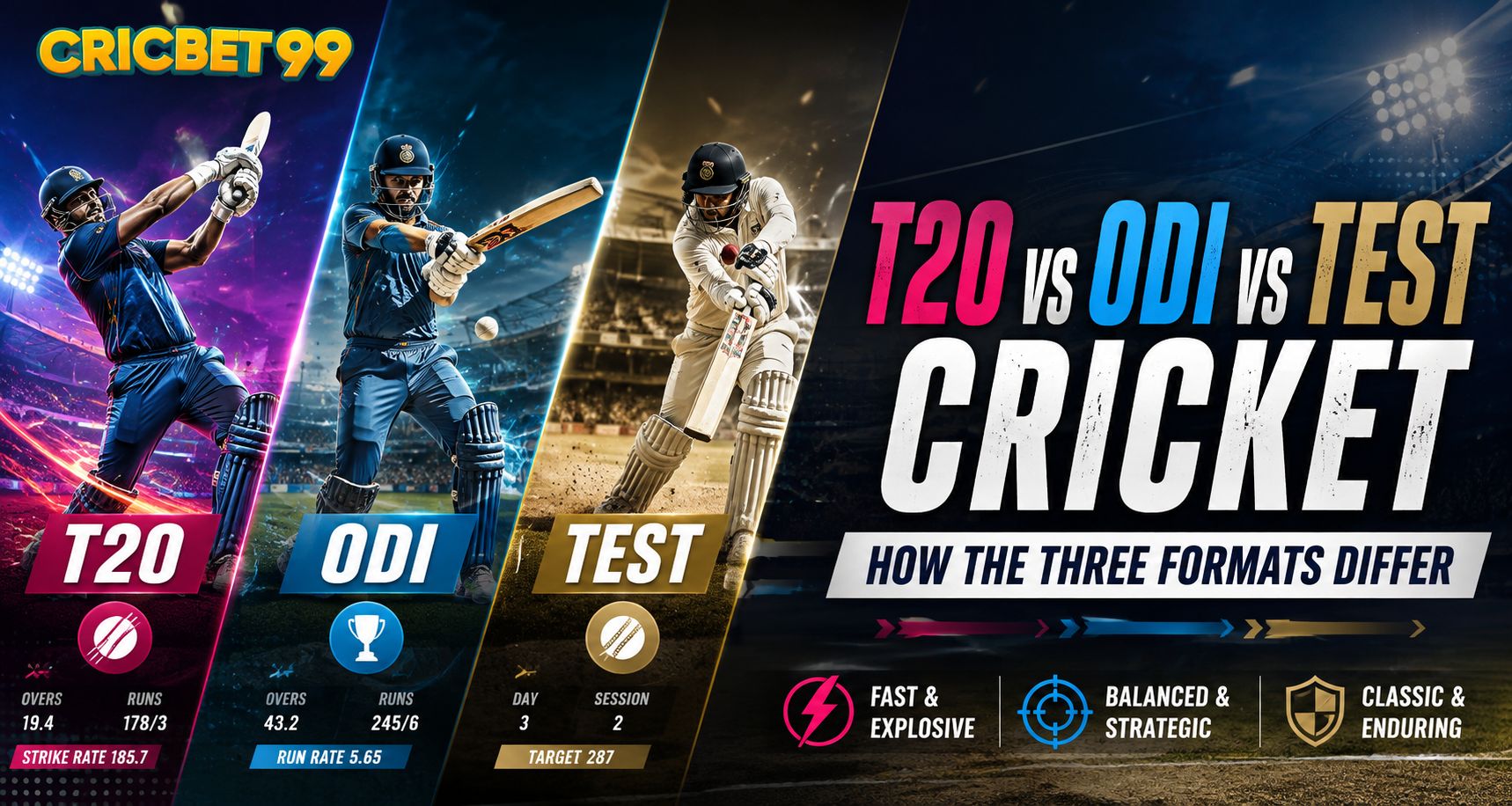
Cricket is unusual because the same basic sport is played in three international formats that demand very different skills and strategies. For fans following matches through Cricbet99, understanding those differences makes it easier to appreciate why a player can dominate T20 cricket but need a completely different approach in Tests. The ICC recognises three international formats: Test matches, One-Day Internationals and Twenty20 Internationals, each governed by its own playing conditions.
What Is Test Cricket?
Test cricket is the oldest and longest international format. The ICC describes it as the traditional form of the game, played over as many as five days with each team normally having two innings.
Unlike limited-overs cricket, a Test innings does not have a fixed 20-over or 50-over limit. This gives batters more time to construct innings and allows bowlers to develop longer tactical plans.
For users checking cricket content through Cricbet99 Login, the major characteristics of Test cricket include:
- Up to five days of play
- Two innings per team
- Greater emphasis on patience and technique
- Longer bowling spells
- Changing pitch conditions across several days
- Greater importance of endurance and concentration
The ICC specifically highlights endurance, technique and temperament as essential Test-match qualities.
What Is ODI Cricket?
One-Day International cricket sits between Tests and T20s.
Each team receives one innings of up to 50 overs, meaning a complete match is designed to finish within a single day. ODIs became an international format in 1971 and developed into one of cricket's major forms, including the ICC Cricket World Cup.
For Cricbet99 Com readers, ODI cricket combines elements of patience and aggression.
A team cannot normally attack every delivery as aggressively as in T20 cricket because 50 overs must be managed, but there is also far less time than in a Test.
Successful ODI teams often need to:
- Preserve wickets during difficult periods
- Rotate strike through the middle overs
- Accelerate toward the end
- Manage bowlers across ten-over allocations
- Adapt quickly to changing match situations
Current ODI playing conditions also differ from earlier eras. Since July 2025, two new balls are used for the first 34 overs before the fielding side selects one for the remaining 16 overs.
What Is T20 Cricket?
Twenty20 is international cricket's shortest established major format.
Each team has a single innings of up to 20 overs. The ICC describes T20I cricket as the newest, shortest and fastest international format and notes that a match usually takes roughly three hours.
For people following Cricbet99 Online Betting content, this shortened structure explains why T20 matches can change so quickly.
Batters generally have less time to settle, while bowlers have only four overs each in a standard completed innings. As a result, teams place greater emphasis on immediate impact.
Typical T20 skills include:
- Boundary hitting
- Innovative batting shots
- Yorkers and slower balls
- Powerplay aggression
- Specialist death bowling
- Athletic fielding
- Flexible batting orders
T20 vs ODI vs Test: The Main Differences
The simplest comparison is based on time and innings.
Test Cricket
- Maximum duration: five days
- Innings: two per team
- Fixed overs per innings: No
- Main challenge: endurance, technique and long-term tactics
ODI Cricket
- Duration: one day
- Innings: one per team
- Maximum overs: 50 per side
- Main challenge: balancing stability with acceleration
T20 Cricket
- Duration: usually around three hours
- Innings: one per team
- Maximum overs: 20 per side
- Main challenge: scoring or taking wickets quickly
These basic structures are defined by the ICC and explain why Cricbet99 Betting Site followers can see dramatically different tactics from the same players across formats.
Why Does Batting Strategy Change?
The number of available deliveries affects how much risk batters can take.
In Test cricket, leaving a dangerous delivery can be an excellent decision because preserving the wicket may matter more than scoring immediately.
In ODIs, batters usually need to balance wicket preservation with maintaining a competitive scoring rate.
In T20 cricket, dot balls can create immediate pressure because only 120 legal deliveries are normally available to each side.
For Cricbet99 Login users, this is why strike rates and batting averages should always be interpreted in the context of the format.
How Does Bowling Change Across Formats?
Bowlers also need different plans.
Test bowlers can work on a batter over several overs, repeatedly targeting a weakness. ODI bowling demands control while also managing different phases of a 50-over innings.
T20 bowlers have the least margin for error. One expensive over represents a significant portion of their available spell.
Cricbet99 Online Betting readers may therefore notice greater use of slower deliveries, wide yorkers and frequent tactical changes in T20s compared with longer-format cricket.
Why Some Players Perform Better in One Format
Being an outstanding cricketer does not automatically mean producing identical results everywhere.
Different formats reward different qualities. Test cricket may favour defensive technique and concentration, while T20 cricket can reward explosive power and improvisation. ODI cricket often requires players capable of switching between both approaches.
For Cricbet99 Com followers, comparing players across formats without considering these different demands can therefore be misleading.
Conclusion
Test, ODI and T20 cricket use the same fundamental skills, but their structures create three very different contests.
Test cricket provides up to five days and two innings per team, ODI cricket gives each side 50 overs, while T20 cricket reduces that to 20 overs.
For Cricbet99 users, understanding these differences makes tactics, player roles and match situations easier to interpret. Cricbet99 Betting Site readers should remember that performances in one format cannot always be directly compared with another because the time, risk and strategic demands are fundamentally different.
FAQs
What is the biggest difference between T20, ODI and Test cricket?
The biggest differences are match length and innings structure. Tests last up to five days with two innings per team, ODIs allow 50 overs per side, and T20Is allow 20 overs per side.
Which is the shortest cricket format?
T20I is the shortest of the three major international formats and usually lasts around three hours.
How many overs are played in an ODI?
Each team can bat for a maximum of 50 overs in a standard completed ODI innings.
How many innings does a team get in Test cricket?
Each team normally has two innings in a Test match, which can run for up to five days.
Why do players use different strategies in each format?
The available time and number of deliveries change dramatically between formats. Tests reward patience and endurance, ODIs require balance, and T20s place greater emphasis on rapid scoring and immediate impact.